
Financial collapse doesn’t announce itself with fanfare. Sometimes it arrives quietly, in the form of a pink slip, a broken-down car that can’t be fixed, or a school withdrawal letter. For countless Nigerian families, economic instability is the daily arithmetic of survival, where every naira must justify its existence and even education becomes a luxury to reconsider.
This reality shaped Unyime Udi‘s earliest understanding of the world. When her father lost his job, the family’s anchor vanished overnight. The good school became unaffordable. Three meals became negotiable. The car sat immobile, a daily reminder of diminished circumstances. Church services that once required a short drive now demanded long walks.
Instead of feeling defeated, young Unyime chose to contribute. During holidays, she sold snacks and small items to cover her school needs. Those seasons built resilience, responsibility, and an unshakeable determination to succeed regardless of circumstances. They taught her that setbacks aren’t endpoints but training grounds for strength and purpose.
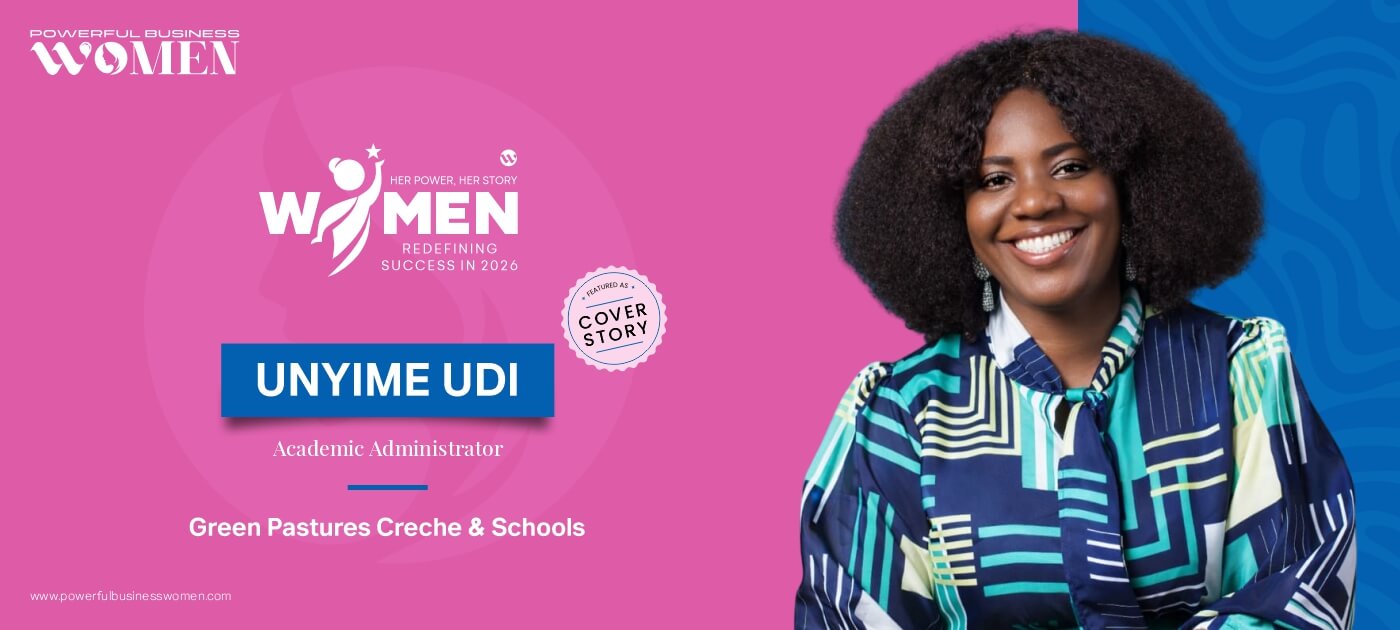
Today, Unyime stands as Academic Administrator at Green Pastures Creche & Schools. But that title barely captures what she’s building: a different kind of future for Nigerian education, one refusing to accept that quality learning should be determined by family bank accounts.
The Unlikely Transition
Eleven years ago, education wasn’t part of Unyime’s blueprint. Medicine was the path she intended to pursue. But purpose announced itself through discomfort. Children in her community couldn’t read. Not struggling readers needing extra support, but children lacking basic literacy skills.
“If someone had told me eleven years ago that I would be able to start and run a thriving school and make a significant impact in education, I would have laughed in disbelief,” she reflects.
That doubt was reasonable. The medical field offered clear pathways and measurable outcomes. Education, particularly entrepreneurial education in Nigeria, offered no such securities. But Unyime had learned something essential during those difficult childhood years: confidence isn’t a prerequisite for action; it’s often a byproduct.
She started Green Pastures with two babies in a single room. Limited resources meant every decision carried weight. Established schools had infrastructure, reputations, and full class offerings. Green Pastures had conviction and little else. Parents understandably hesitated, raising doubts “why enroll your child in an unproven school when established options existed”.
Rather than becoming defensive, Unyime returned to school to study education and obtained a Diploma in Education and Masters in Educational Planning and Administration, enrolled in professional development courses, conducted research across three education zones studying school resources and educational quality. She wanted to understand the deeper systemic patterns determining why some schools succeeded while others struggled.
Unlearning the Myth of Passion
The biggest barrier Unyime faced was an internal assumption she had to consciously dismantle.
“The biggest barrier I had to overcome was the belief that passion alone was enough,” she explains. “I had to unlearn that and embrace the importance of structure, professional knowledge, and systems.”
This realization represents a crucial maturation many mission-driven leaders resist. Passion is essential but insufficient. It can ignite a school; it cannot sustain one. Systems can. Structure can. Professional knowledge can.
Her master’s program research exposed best practices, revealed gaps in her approach, and illuminated areas where Green Pastures could evolve. That research sharpened her passion with precision.
The shift paid off. Parents who initially hesitated began noticing outcomes. Children were genuinely developing literacy and comprehension skills. The school that started with two babies in one room now operates with all grade levels fully established. That growth resulted from marrying vision with operational competence.
The Transformation That Matters
Ask Unyime about her proudest achievement, and she doesn’t point to institutional metrics or enrollment numbers. She points to individual children.
“The most meaningful achievement for me is the transformation I have witnessed in children’s lives. My journey into education began when I noticed that many children around me could not read. That reality was disturbing and gave me sleepless nights.”
Those sleepless nights transformed into profound satisfaction. Children who once stumbled over basic words now read fluently, spell accurately, engage meaningfully with texts.
“The joy and relief on the faces of their parents is something I cherish deeply. Knowing that a child’s academic confidence and future has been positively redirected has an impact in its purest form.”
This focus on individual transformation over institutional expansion reveals something essential about Unyime’s leadership philosophy. Scale matters only insofar as it enables more individual transformations. Numbers are meaningful only when they represent actual children gaining actual skills shaping actual futures.
Redefining Success Through Multiplication
Since then, Unyime’s definition of success has evolved significantly. Running a successful school once felt like the destination. Now it feels like the beginning.
“Success to me in 2026 is not just about personal accomplishment; it is about multiplication of impact. It means seeing aspiring school founders under my guidance start and successfully run schools that address real educational challenges our society is facing.”
She’s launching “The School Founder’s Blueprint,” a mentorship platform guiding prospective school founders through practical realities of starting and sustaining educational institutions. Rather than offering theoretical content from research, it will offer hard-won wisdom extracted from actual experience.
“Having started a school from scratch with just two babies in a room and grown it into a full-fledged school, I understand the journey, the mistakes, the lessons, and the systems required.”
Her definition now encompasses legacy, sustainability, and impact extending beyond her direct reach. She’s not content running one excellent school. She wants to enable dozens, perhaps hundreds, of others to do the same, creating a multiplier effect addressing Nigeria’s educational challenges at a scale individual institution cannot achieve alone.
The Leadership Women Bring
When asked what advice she would give women who feel pressured to diminish themselves in leadership spaces, Unyime’s response is direct.
“I always tell women this: you carry immense value. You have so much to offer, and that is exactly why leadership spaces need you. Women are exposed to diverse life experiences that broaden their understanding and empathy. Those experiences are strengths, not weaknesses. Leadership is about guidance, influence, and nurturing growth, and these are qualities women naturally embody.”
She rejects the narrative that women must adopt masculine leadership styles to succeed. The qualities often dismissed as “too soft”, such as empathy, relational intelligence, and nurturing instincts, are actually essential leadership competencies, particularly in education.
“Do not shrink yourself to fit into spaces. Lead confidently, knowing who you are and what you can bring to the table. The world does not need a smaller version of you; it needs the fullness of your capacity.”
This advice carries weight from someone who came from the medical field, transitioned into education, started a school built from almost nothing in an established market. She had every reason to feel inadequate. Instead, she chose competence over credentialism, learning over pedigree, results over resume building.
The Faith and Curiosity Foundation
Ask Unyime to describe herself beyond titles, and faith emerges as the organizing principle.
“At my core, I’ll say I am deeply curious and faith-driven. I am a lover of God, and my faith shapes how I see people, purpose, and leadership. I have a strong appetite for knowledge, which naturally makes me a reader and an explorer. Curiosity pushes me to ask questions, research deeply, and never settle for surface-level understanding. It is this trait that keeps me growing, improving, and seeking better ways to solve problems, especially in education.”
This combination creates productive tension. Faith provides the “why”, being the moral imperative to serve children others might overlook. Curiosity provides the “how”, where she constantly investigates into better methods, more effective systems, and deeper understanding of educational best practices. Together, they ensure conviction drives action while continuous learning makes that action increasingly effective.
The Generational Vision
When Unyime speaks about International Women’s Day 2026, she doesn’t offer platitudes about empowerment. Her message is more specific and more demanding.
“Your impact as a woman goes far beyond what you can see. One decision, one action, one act of courage from you does not just influence one, two or three persons; it influences generations. So do not stop making impact wherever you find yourself. Your presence, your voice, and your contributions may be the answer to someone else’s prayer.”
This generational framework elevates individual actions beyond immediate visibility. The parent you help today raises children differently tomorrow. The teacher you train shapes hundreds of students over a career. The school founder you mentor creates an institution that outlives you both.
Her boldest aspiration reflects this thinking: “My boldest aspiration is to become an educational leader whose contributions and influence in the education sector outlive me and continue to shape lives for generations.”
If her systems work, if her mentorship platform succeeds, if the frameworks she’s developing can be taught and replicated, impact extends far beyond her individual lifetime. Schools will be started by people she trained who will educate children she’ll never meet, creating cascading effects across generations.
The Message to Young Women
Unyime’s final thoughts focus on young women wrestling with self-doubt, a challenge she knows intimately.
“Many young women second-guess themselves and allow self-doubt to take the lead. I want my story to challenge that mindset. Background limitations do not have to determine your future. I started small, with very little, and built step by step. Growth is possible when you start from where you are, with what you have, and remain consistent.”
This message gains credibility from her biography. She started with genuine disadvantages: financial instability during childhood, no established reputation, minimal resources. Those weren’t just minor inconveniences, but substantial barriers justifying giving up or choosing safer paths.
“I hope my journey encourages young women to dream boldly, take action despite fear, and refuse to let their present situation define their potential.”
That refusal to let present circumstances dictate future possibilities is hard-won realism from someone who lived it. The girl trekking to church because the family car broke down became the woman establishing educational institutions. The teenager selling snacks during holidays to cover school expenses became the administrator training other school founders.
Unyime’s journey suggests that ordinary people, starting from difficult circumstances, can create meaningful impact through sustained commitment to learning and serving others.
The schoolchildren at Green Pastures learning to read, the aspiring school founders preparing to launch institutions, the young women reconsidering what they’re capable of achieving—these are the compounding effects of one woman’s decision, made years ago, to let a disturbing observation about illiterate children become a catalyst for action.
That choice, multiplied across time and amplified through systems designed to help others make similar choices, is how individual impact becomes generational transformation. It’s how two babies in a single room becomes a fully established school. It’s how one woman’s journey from hardship to hope becomes a blueprint others can follow, adapt, and build upon.