

Artificial intelligence has moved beyond the confines of research labs and keynote stages. It now sits quietly inside decisions that shape healthcare outcomes, financial access, supply chains, and even how trust is measured in digital spaces. Yet, as AI systems grow more powerful, the conversation around them has become increasingly fragmented. Speed is celebrated, scale is rewarded, but responsibility often arrives as an afterthought. The industry speaks fluently about innovation; it struggles when asked about accountability, context, and consequence.
This tension is not lost on leaders who have spent decades watching technology cycles repeat themselves. They have seen how every major breakthrough brings both promise and risk, how tools meant to simplify can also exclude, and how intelligence without ethics can quietly erode confidence. What the AI ecosystem needs now is not louder ambition but steadier judgment. Not just builders of algorithms, but stewards of impact.
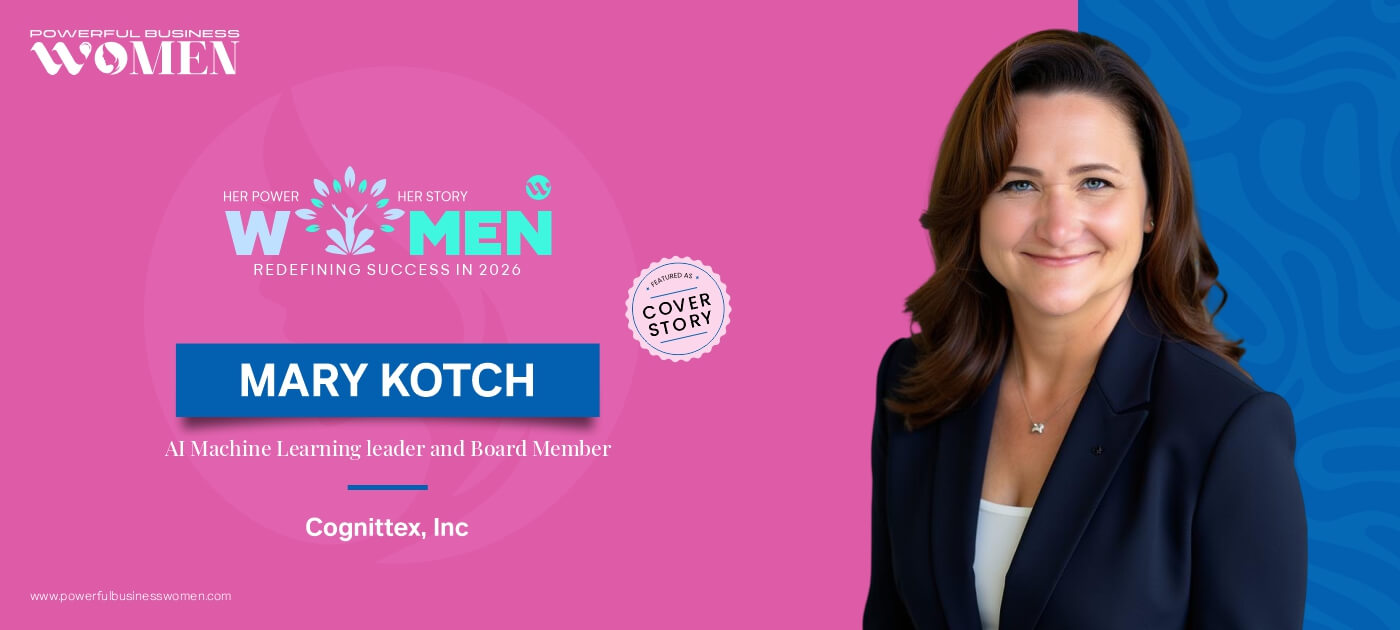
Mary Kotch career has unfolded precisely at this intersection.
A technology executive and educator with more than 20 years of experience, Mary has led large-scale AI, cybersecurity, and digital transformation initiatives across fortune 100 & 500 highly regulated industries. Alongside her industry leadership, she teaches at Penn State University, focusing on AI, cybersecurity, and decision-making in complex systems, while advising organizations on the responsible application of advanced AI in healthcare and cyber defense. She also serves on the board of CogniTTex, an artificial intelligence solutions company committed to addressing some of humanity’s most pressing healthcare challenges.
The Blueprint Built on Resourcefulness
Mary’s approach to leadership didn’t form in a vacuum. It came from watching women around her solve problems with creativity and persistence, often with fewer resources than their male counterparts. That resourcefulness became her blueprint, a way of seeing obstacles not as barriers but as puzzles requiring different angles of attack.
“When tools didn’t exist, we built them. When doors didn’t open, we found windows,” she reflects on those formative years. The lesson wasn’t just about resilience. It was about recognizing that the rules others followed weren’t written for women like her, so following them would never lead where she needed to go.
That early self-taught foundation in AI and machine learning gave her more than technical skills. It proved something deeper: she could chart her own course. Growing up, she learned that asking questions wasn’t a weakness; it was a superpower. While others hesitated to reveal what they didn’t know, Mary recognized that curiosity was a career strategy, one that would serve her far better than pretending to have all the answers.
Building Bridges Between Worlds
Strip away the titles and achievements, and what remains is simpler: a learner and a teacher, sometimes in the same breath. For years, Mary has taught part-time at Penn State University alongside her executive roles, a choice that might puzzle those who see teaching as a step down from corporate leadership. But for her, helping students secure internships and watching them discover how AI will advance their careers feeds something corporate success never could.
This dual existence, one foot in the boardroom and one in the classroom, reveals her core belief: knowledge isn’t meant to be hoarded. It’s meant to be shared. She’s spent her career translating complex technical concepts into practical understanding because she believes everyone deserves access to knowledge, not just those with advanced degrees or insider connections.
Beyond work, she’s deeply curious about how things connect. Data flows, human behavior, organizational dynamics; she sees patterns everywhere and finds joy in making sense of complexity. That ability to find the signal in the noise and help others see it too defines her approach to both technology and leadership. She builds bridges between data and decisions, between technology and the humans who use it, between experienced professionals and the next generation.
Redefining Success Through Multiplication
Ask Mary what success looks like now, and the answer reveals how far she’s traveled from those early days of proving she belonged. In her twenties, success meant hitting metrics, earning titles, gaining respect in rooms where women were scarce. In her thirties, it expanded to building things: teams, systems, solutions that outlasted any single project.
But success in 2026 means something entirely different. It means multiplication. “It’s not about what I accomplish alone but what I enable others to accomplish. When a student I mentored lands their dream internship, that’s success. When a team member who once feared AI becomes its biggest advocate, that’s success. When my organization uses technology to work smarter and more humanely, that’s success.”
This shift from personal achievement to collective impact didn’t happen overnight. It required unlearning the metrics that had once defined her worth. Success now also means integration, refusing the false choice between ambition and authenticity. For too long, women were told they had to shrink parts of themselves to fit leadership molds designed by others. Mary learned that her full self; curious, nurturing, demanding, playful, is exactly what effective leadership requires.
She carries with her a quote from Madeleine Albright that has stuck with her for years: “There’s a special place in hell for women who don’t help women.” It’s more than inspiration. It’s a mandate that shapes how she shows up every day.
The Moment Fear Took the Backseat
The shift from self-doubt to self-belief rarely happens in a single moment, but sometimes one experience crystallizes years of gradual change. For Mary, it came early in her career during a presentation to senior leadership, all men. She was halfway through explaining a data architecture recommendation she’d built when one executive interrupted. Instead of asking her to clarify, he turned to a junior male colleague and asked him to explain her own proposal.
Without thinking, she said, “I appreciate the interest, but I built this system and I’ll finish explaining it.”
The room went quiet. Her heart pounded. But she continued, and by the end, her recommendation was approved.
That moment taught her something fundamental: self-belief isn’t the absence of fear. It’s acting despite it. She realized that waiting for permission or validation was a trap. No one was coming to anoint her as credible. She had to claim her own expertise. From then on, she stopped apologizing for her knowledge and started owning it. The self-doubt didn’t disappear overnight, but she learned to act before it could paralyze her.
Unlearning Perfectionism
The external barriers were obvious and easier to name: being the only woman in rooms full of men, having her technical competence questioned, watching less qualified peers advance faster. Mary learned to navigate those through preparation, persistence, and strategic relationship-building.
But the bias that took longest to unlearn was internal: the belief that she had to be perfect to be taken seriously. While male colleagues could propose half-formed ideas and iterate publicly, she felt she needed airtight solutions before speaking. That perfectionism was both protective and limiting, a shield that also became a cage.
Unlearning it required intentional practice. She started sharing work-in-progress ideas, asking questions she didn’t know the answers to, and modeling vulnerability for her teams. It took years to internalize that competence doesn’t require perfection and that admitting uncertainty often builds more trust than pretending to know everything.
This evolution in her thinking now shapes the advice she gives women who feel they must conform or shrink themselves to fit into leadership spaces. First, recognize that the discomfort you feel isn’t your flaw; it’s a signal that the space wasn’t designed for you. That’s not a reason to shrink. It’s a reason to expand.
Second, find your people. Build relationships with others, women and men, who see your full value. Their belief will sustain you when self-doubt creeps in. Mary has been fortunate to work with colleagues who became true partners, and those relationships carried her through moments when conformity felt easier.
Third, remember that every authentic leader who came before you made room for you by refusing to shrink. When you show up fully, you’re not just claiming space for yourself; you’re opening doors for women watching and learning from your example.
Finally, distinguish between strategic adaptation and self-abandonment. Learning to read a room and communicate effectively isn’t shrinking; it’s skill. But silencing your ideas, hiding your expertise, or pretending to be someone you’re not? That’s a cost too high to pay.
What Matters Most
Ask Mary about her most meaningful achievement, and she won’t point to a promotion or a high-profile project. The achievement that matters most is the students she’s mentored who now lead their own teams. One former student recently messaged her to say she’d just been promoted to a data engineering role, and she credited their conversations about understanding data foundations, not just AI tools, as the turning point.
That single message meant more than any corporate recognition. Technology changes constantly, but the ability to help someone see their own potential and develop skills that will serve them for decades carries lasting impact. When she eventually steps back from executive roles, it won’t be the dashboards or systems she remembers. It will be the people who grew because someone invested in them.
A Message for Women Everywhere
On International Women’s Day 2026, Mary’s message is direct and unapologetic: “Your expertise is valid. Your perspective is needed. Your voice matters, especially when it shakes.”
We’re living through a technological transformation that will reshape every industry and role. AI isn’t something happening to us; it’s something we can shape. Women must be at the table designing these systems, governing their use, and ensuring they serve everyone.
Don’t wait for permission to learn, to lead, or to speak. Take the free courses from MIT, Stanford, Microsoft, and others. Ask the uncomfortable questions. Build the skills that will make you indispensable. And then reach back and help another woman do the same.
Building the Next Generation
Mary’s boldest aspiration centers on democratizing AI and data literacy, making these skills accessible to people who’ve been excluded from traditional technology education. That means expanding her teaching, creating resources that meet people where they are, and advocating for pathways that don’t require expensive degrees or insider connections.
She wants to build a generation of leaders, especially women, who understand both the power and the limitations of AI, who can harness these tools without being intimidated by them, and who ensure technology serves human flourishing rather than replacing human judgment.
Her story offers proof that there’s no single path to leadership. She didn’t follow a traditional trajectory. She taught herself through free MIT courses, built expertise across data and cybersecurity, and combined executive roles with teaching because both mattered to her.
She wants young women to see that curiosity is a career strategy. That asking questions and admitting what you don’t know is strength, not weakness. That you can be technical and nurturing, ambitious and generous, serious and joyful, all at once.
Most importantly, she wants them to understand that the future isn’t fixed. The AI systems being built today will shape tomorrow’s world, and women must help build them. Your voice, your perspective, your leadership isn’t optional; it’s essential. Don’t wait to be invited. Step forward. The world needs what you have to offer.