
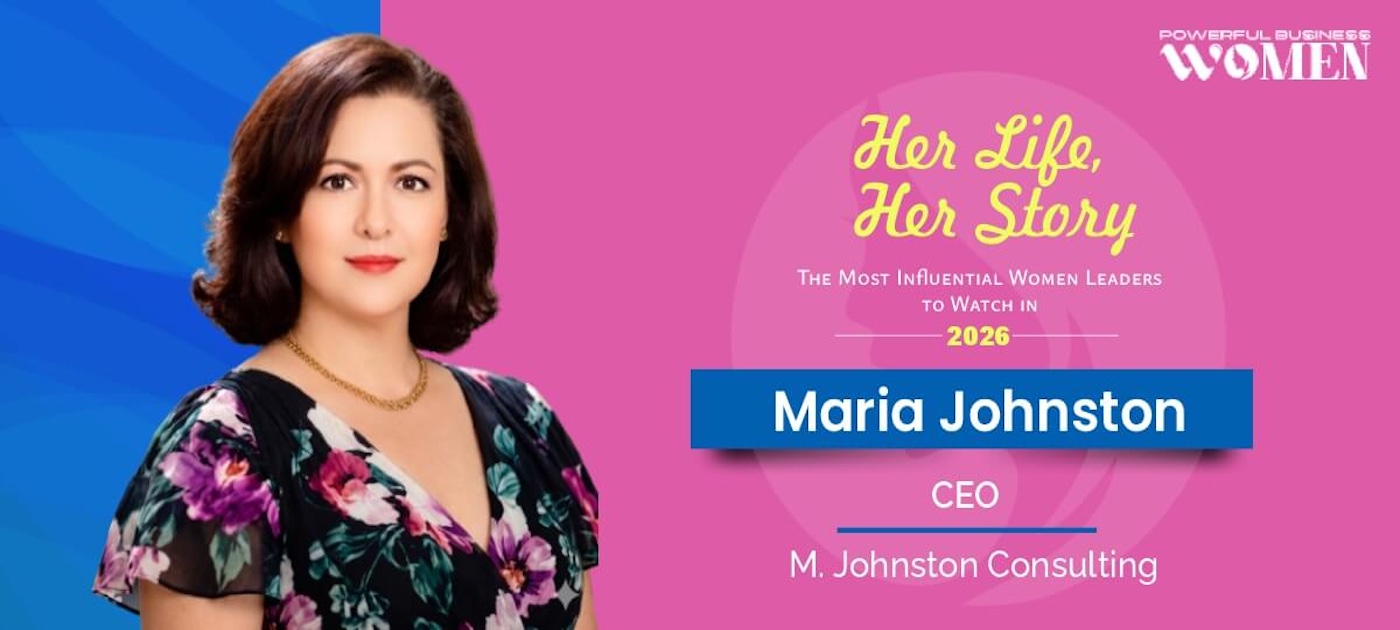

Telecommunications and utilities are industries where change rarely happens quietly. Technology keeps moving, customer expectations continue to evolve, and businesses must respond to regulatory, legislative, and market shifts while keeping essential services running. Behind that work are professionals who understand both the technical side of the industry and the people, decisions, and strategies that keep it moving forward. Leadership in such an environment calls for experience, adaptability, and the confidence to step into rooms where difficult decisions are made.
Maria Johnston, MBA, RCDD, has spent more than three decades working across the utility and telecommunications landscape, developing a career that brings together technology, business strategy, legislative affairs, and leadership. As CEO of M. Johnston Consulting, LLC, she draws on more than 30 years of industry experience, including extensive work in lobbying and legislative affairs. Throughout her career, she has led multifaceted teams, developed strategies to support business growth, strengthened customer relationships, and worked with evolving products and technologies.
Her career began in 1981 with Southern Bell Telephone and Telegraph in Miami, Florida. Over the years, she moved through numerous leadership roles within the technology industry, building expertise across areas that demanded both technical knowledge and business judgment. Her professional journey also established her as a confident public speaker and strategic negotiator, with a continuing interest in industry developments and emerging technologies.
One of the milestones that stands out in her technical career came in January 1996, when Maria earned the Registered Communications Distribution Designer (RCDD) certification. She became the first female employee in the AT&T/BellSouth nine-state region to earn the certification, marking an important achievement in an industry where women were often underrepresented in technical and engineering roles.
Her academic journey has complemented that technical foundation. Maria holds an MBA in Strategic Management from Regis University in Denver, Colorado. She is also a graduate of Leadership Florida Class XXXIV and a participant at Harvard’s Executive Education program, continuing to expand her perspective beyond the technical side of telecommunications and into broader questions of leadership, strategy, and business.
Recognition has followed her work over the years, including the Hispanic Leadership Award in Technology from the South Florida Hispanic Chamber and the Service Excellence Award from AT&T. Her leadership has also extended beyond her professional responsibilities through extensive board and community involvement.
Maria has served on the Executive Board of the Beacon Council, Miami-Dade County’s official economic development agency, where she chaired committees including Finance, Legislative, and Membership. She has also served on the Miami Dade College Foundation Board, where she was Co-Chair of the Legislative Committee, as a Director on the Miami Children’s Hospital Foundation Board, and on the Leadership Broward Foundation Executive Board, where she served as Vice President of Leadership.
Maria’s career reflects more than professional progression, it is a story of technical expertise developing into broader leadership, with each chapter adding another dimension to the work she continues to do.
The Goals She Wrote on Her Bedroom Wall
Maria’s determination to become independent began at home. She grew up watching her parents argue about money, sometimes over as little as $10. Her mother was a stay-at-home mom, while her father was the one who worked. Whenever her mother needed money for food or clothes, she had to ask her husband for it.
At 13, Maria started thinking about the kind of life she wanted for herself. After hearing another argument about money, she went to her bedroom and wrote two goals on the wall: be financially independent and get a college education.
She did not know exactly how she would achieve them, so she started asking questions. She spoke with her friends’ parents about college, how they applied, and what she needed to do. Most gave her the same advice: when she reached her junior year of high school, the counselor would explain the process, but she needed to maintain good grades.
Maria was a straight-A student, so she was excited when the time came to meet her counselor. She entered his office expecting guidance about college and her future. Instead, after looking through her records, he told her that because she was a Hispanic female, she should get married, have children, and forget about having a career.
Maria left the office crying. Then she got angry. When she returned home, she added a third goal to the wall: Don’t let anyone tell -you what you can or can’t do with your life.
That experience became one of the forces behind her book, Don’t Let Anyone Tell You. It also became part of the mindset she carried into the rest of her life. She became financially independent after starting work at a phone company at 18, and over time achieved her goal of getting a college education.
Many other experiences shaped her journey, but she also points to ethics and meeting her incredible husband as important parts of the life she has built.
Ambition is Part of the Personality
Behind Maria’s professional achievements is someone who genuinely enjoys setting goals and reaching them. She describes herself as a fun person who loves having something to work toward.
Goal-setting has always been part of her personality. Whether the objective was connected to education, financial independence, her career, or something personal, she has enjoyed the challenge of figuring out how to reach it. Some people may call that determination crazy, but Maria has never been afraid of having ambitious goals and going after them.
Choosing a New Chapter
Maria’s definition of success changed as her career developed. She spent years working for a large company, where she achieved numerous goals and received various awards. She had built a successful career, yet eventually realized that she was bored and needed to make a change.
That realization led her into business ownership, something she had never imagined doing earlier in her career. Stepping into that unfamiliar territory became one of the best decisions she made professionally.
Owning her own business gave Maria a different direction and a new reason to stay challenged. Her experience taught her that success can also mean recognizing when it is time to leave a comfortable path and have the courage to pursue something different.
When Someone Else Tried to Define Her Future
One of the most defining moments in Maria’s life came during her high school years, when her counselor told her that a career was not the right path for her because she was a Hispanic female. The experience was painful, but it did not create self-doubt. Maria says she always believed that goals could be achieved. What mattered was finding the right way to get there.
When something stood in her way, she learned to modify her plan rather than give up on the destination. The process was not always easy, but she kept moving forward, adjusting whenever necessary and finding another route when the original one no longer worked.
That mindset has remained a constant throughout her life. Maria does not see obstacles as a reason to abandon a goal. She sees them as a reason to rethink the plan. Looking back, she can say that every goal she has set for herself has been achieved.
The Pursuit Matters as Much as the Achievement
Being a female engineer in the telecommunications industry came with its own set of challenges for Maria. She remembers a meeting that clearly reflected the assumptions she often encountered.
Maria had engineered the voice and data network for a project, with technicians reporting to her and installing the fiber and copper facilities based on her design. One day, the owner of the company wanted to meet with her to understand the design. About 15 minutes into their conversation, he asked when her boss would arrive.
Maria looked at her employee, who looked back at her, and then explained that she was the boss and the person who had engineered the voice and data network. The owner immediately became embarrassed after realizing that he had assumed the person responsible for the project would be a man.
It was not an isolated experience. Maria encountered similar situations many times during her career. When she went into the field to check the work she had designed, technicians would sometimes ignore her or avoid speaking with her when she asked whether they had questions about the design.
Eventually, she found her own memorable way to make her presence clear. She began wearing skirt suits with steel-toe boots when she visited the field. The combination made a point without requiring an explanation, and Maria can still laugh about it today.
Never Make Yourself Smaller
Maria has never believed that women should change who they are simply to fit into leadership spaces. Her advice is direct: do not conform or make yourself smaller. She believes the better approach is to identify the walls standing in the way and develop a plan to get around them. That plan may need to change as new obstacles appear, but changing the route does not mean giving up on the destination.
A passage from the late college professor Randy Pausch has remained particularly meaningful to her because it reflects the way she has approached challenges throughout her life. His words describe brick walls as obstacles that reveal how badly someone wants what lies beyond them.
That idea has stayed with Maria. Obstacles are part of the journey, but they do not have to decide where the journey ends.
The Certification That Changed Her Career
One of Maria’s most meaningful professional achievements came when she passed the RCDD exam and became the first female certified engineer at a company that had more than 80,000 employees at the time. The achievement was significant not simply because of the recognition attached to it, but because of what it changed. The certification opened a new direction in her professional life and changed the course of her career.
It became a milestone that represented much more than passing an examination. It showed Maria what could happen when she continued pursuing opportunities despite the barriers she had encountered along the way.
A Bucket List That Keeps Growing
Maria’s next chapter is less about professional milestones and more about experiences. She wants to travel the world. She has already checked many unforgettable experiences off her bucket list, including jumping out of a plane, riding in a hot air balloon, flying in a helicopter, traveling to Egypt, and going inside the pyramids. Each experience has given her another memory to carry forward, and instead of finishing her bucket list, she continues adding countries to it.
Business still has a place in her plans. Maria expects to work for another five years, with the goal of keeping the business moving forward and eventually handing it over to her son.
The next chapter, then, brings together two things she values: experiencing more of the world and creating something her son can continue.
A Story That Gives Others Courage
Maria has spoken to many women and young women in high school, and some of the most meaningful moments have come after those conversations. Women have approached her afterward to tell her that her story gave them encouragement when they were facing challenges of their own.
Some had believed that the obstacles in front of them were too difficult to overcome. Hearing about Maria’s own challenges and the way she worked through them helped them look at their situations differently.
That is the impact she hopes her story continues to have. Maria wants women to understand that they can pursue whatever they want in life. The path may not always be straightforward, but having a goal and making a plan can be the beginning of finding a way forward.