
Leadership education has long suffered from a peculiar contradiction. Business schools teach all the mechanics of running organizations be it strategy, finance, operations, or marketing. But too many ignore the single most predictive factor of leadership success: the ability to build genuine human connection. Generations of executives have climbed corporate ladders armed with spreadsheets and frameworks, only to discover their greatest challenges aren’t technical problems but people problems. The emotional landscape of teams. The messy reality of trust. The vulnerability required to inspire rather than merely manage.
This gap between what’s taught and what matters has created a leadership crisis, particularly in the technology sector where brilliant engineers become founders overnight, tasked with leading companies that will shape humanity’s future despite having little to no training in the human dynamics that determine whether their vision succeeds or fails. Most leadership development remains locked behind the gates of elite institutions, accessible only to those with six-figure budgets and the privilege of stepping away from their companies for extended periods.
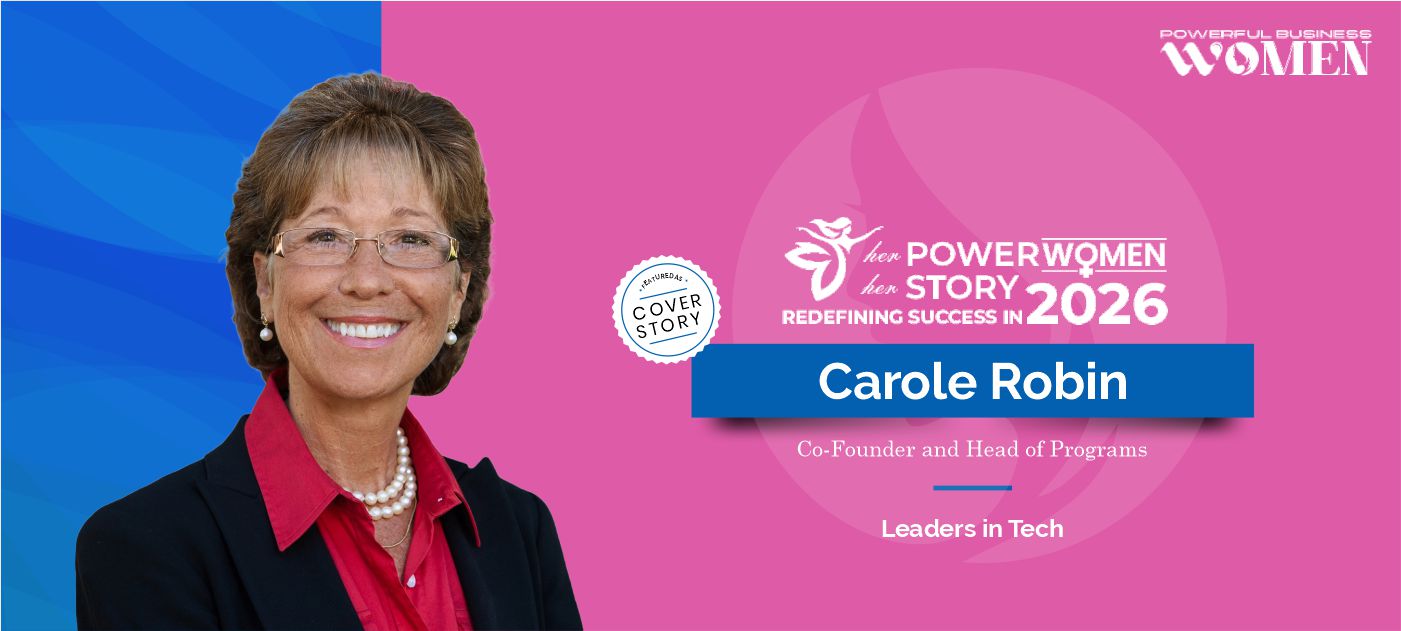
Carole Robin has spent 9 years working to close that gap. As Co-Founder and Head of Programs at Leaders in Tech, she’s on a mission to democratize what she calls the “Carole Robin Curriculum”, based on everything she once taught at the Stanford Business School, a human-centered approach to leadership that treats emotions not as obstacles to professionalism but as essential tools for effectiveness. Her journey from corporate executive to Stanford’s “Queen of Touchy Feely” to nonprofit founder reveals what happens when someone refuses to accept artificial limitations on what’s possible.
Learning Power Before She Had the Language for It
At fourteen, Robin made a decision that would quietly shape the rest of her life. She would become Student Council President. That was not a passing thought, but a deliberate plan. Over the next three years, she watched how influence moved through systems, how decisions were made, and how change happened. When she finally won the role as a senior, something shifted.
The adults around her began telling her she was “born to be a leader.” Her peers thanked her for fixing things that had felt immovable. That validation did more than boost confidence; it set a direction. Leadership, she learned early, was about making life better for the people inside the system.
That pattern repeated with striking consistency in her professional life. In corporate America, Robin became the first woman hired into a non-clerical role at one of the world’s largest industrial automation companies. Promotion followed promotion. And with each step, the message was the same. “You’re a natural leader.”
Those words mattered, particularly in an era when women were rarely invited into rooms where decisions were made. The belief others placed in her expanded her own sense of what was possible. But belief alone was not the lesson she would carry forward. The real reckoning came later, when success exposed its limits.
The Cost of Leaving Feelings in the Parking Lot
Like many women navigating male-dominated workplaces at the time, Robin learned the unspoken rule quickly. Feelings had no place at work. Professionalism meant armor. Distance was protection and initially, credibility.
For a decade, the strategy worked. She climbed. She delivered. She earned her seat. Until one day, she realized her team did not see her as human.
“They saw a manager. A decision-maker. An executor of objectives. But not a person with feelings, fears, hopes, or vulnerabilities.”
What had once been a survival tactic had become a wall. Her effectiveness plateaued, not because of a lack of competence, but because connection was missing. The ceiling she encountered was internal.
Unlearning that conditioning became the most difficult work of her career. It was more difficult than any promotion and more demanding than any professional setback. She had to dismantle the armor that had once kept her safe.
What emerged on the other side reframed everything she believed about leadership.
“Feelings aren’t the enemy of professionalism,” she discovered. “They’re the foundation of genuine connection.”
And connection, she learned, is the foundation of trust, motivation, and leadership that lasts.
Teaching What Few Business Schools Knew How to Name
Robin’s path eventually led her to Stanford Graduate School of Business, where she was invited to teach one of the most talked-about leadership courses in the MBA program. Students nicknamed it “Touchy Feely,” emphasizing the Feely, because the course dealt openly with emotions, vulnerability, and interpersonal dynamics. These were topics business education had long often avoided.
The course was already in great demand, and it was already an oversubscribed elective in the program. Robin helped increase the demand to a whole new level and eventually won the Distinguished Teaching Award. Students crowned her “The Queen of Touchy Feely.”
What made the recognition significant was what it represented. The award placed her at a table almost entirely occupied by men, in one of the most elite institutions in the world. It gave her confirmation.
“What I taught mattered,” she realized. Not just to students, but to the future leaders they would become.
That confirmation did not anchor her at Stanford. It provided the inspiration for what would come next.
Walking Away From Prestige to Build Access
Leaving Stanford surprised some. The platform was secure. The prestige unquestioned. But Robin understood something critical; if this work truly mattered, it could not remain accessible only to those who could afford an elite MBA.
So, she co-founded Leaders in Tech, a nonprofit with a single, audacious goal; to democratize the leadership curriculum she had spent decades refining.
The mission was clear. Get human-centered leadership into the hands of people shaping the digital future, including those influencing AI, ethics, and systems that would impact millions.
The results speak quietly but powerfully. Leaders in Tech has reached over 50,000 employees through companies led by program participants. Founders who have gone through its programs now run startups collectively valued at more than $60 billion. Nearly 10,000 students passed through Robin’s Stanford classroom. Over 170,000 readers have engaged with her ideas through her book. And beyond the numbers are ripples she cannot measure; conversations changed, relationships repaired, leaders choosing humanity over distance.
That, to Robin, is success.
Redefining Success as Ripples
Early in her career, Robin measured success the way many do; titles, recognition, and scale. Today, her metric is different.
“How many leaders are showing up differently?” she asks. “Where are those ideas traveling now, passed from one person to another in conversations I’ll never witness?”
She refuses to separate professional impact from personal life. Forty years of marriage. Two children she is deeply proud of. A new chapter as a grandmother. These are not parallel achievements. They are part of the same story.
What often goes unsaid in conversations about “having it all” is the architecture behind it. Early in their marriage, Robin and her husband made a deliberate pact. They would both be breadwinners. They would both be primary parents at home. Just not at the same time.
When their children were young, Robin stayed home. During that period, she also returned to academia and earned her Ph.D., while her husband’s career advanced. Years later, when their children reached their pre-teen and teenage years, they switched roles. He stepped fully into the role of stay-at-home parent, remaining there until the children left for college, while Robin resumed her professional ascent. That sequencing, intentional and unapologetic, became a defining through-line of her life and part of the circuitous path that eventually led her to Stanford.
“I didn’t just prove the world wrong,” she says of the false choice between career and family, “I built a life proving it was a false choice.”
Her life stands as evidence that ambition and love are not competing forces.
Advice for Women Who Feel Pressure to Shrink
Robin is direct when asked what she would tell women navigating leadership spaces that were not designed for them.
“Step up, unapologetically. And whatever you do, don’t make yourself smaller.”
She draws a sharp distinction between self-advocacy and self-aggrandizement. One is essential. The other is insecurity disguised as confidence. Mastering that difference, she believes, determines long-term success.
Competence, she insists, is non-negotiable. But competence alone is insufficient. Leaders who endure understand people. They build trust. They create relationships that work.
“When you make yourself smaller,” she warns, “you don’t just diminish yourself. You lose credibility.”
Her message is consistent and unwavering; take up room while leaving room for others.
Power, Relationships, and the Work Ahead
On International Women’s Day 2026, Robin’s message is clear. Relationships are not a soft skill. They are power.
“People do business with people,” she says. Not ideas, not strategies, not capital.
Her boldest aspiration is to make human-centered leadership the norm, not an exception. Not an aspiration, but a baseline expectation that reshapes how people live and work.
Her focus now is not on being indispensable, but on building something that outlasts and outgrows her. She is actively empowering leaders who will take the work further, adapt it, challenge it, and evolve it.
“The boldest thing I can do,” she says, “is build something that doesn’t need me.”
Choosing “Can”
Robin traces her sense of possibility back to two men who believed in her before the world did; her father, who told her the sky was the limit if she got out of her own way, and her husband, who reinforced that belief with unwavering support.
But belief from others, she knows, is not enough.
At some point, women must stop waiting for permission. Stop shrinking. Stop getting in their own way.
She was told she could not have a career and a family. She has both. She was told to leave emotions at the door. She built a career bringing them into the room. She was told leadership spaces were not designed for her. She took up space anyway.
“The sky isn’t the limit,” she says. “It’s the starting point.”
Her story stands as proof that leadership does not require erasing humanity. It requires embracing it. And in a world still learning that lesson, Carole Robin remains one of its most persuasive teachers.