

Corporate leadership development, as an industry, has a problem it rarely admits out loud. It spends billions every year on workshops, off-sites, and training programs that yield, at best, a short-lived uptick in engagement scores. Managers sit through sessions and return to the same floors, the same politics, the same pressure to perform without the tools to sustain what they learned. The feedback loops are slow, the development is reactive, and the ladder, especially for women, remains tangled with unspoken rules no formal curriculum ever addresses.
The deeper dysfunction, though, is subtlety. High-performing leaders, the ones trusted with the most complex mandates and the most fragile teams, are often the least likely to receive honest, specific, developmental feedback. Seniority creates a kind of buffer around them. People around them soften their messages. And in the silence, blind spots quietly compound until a relationship fractures, a team stalls, or a leader who was genuinely capable finds herself wondering where it went wrong.
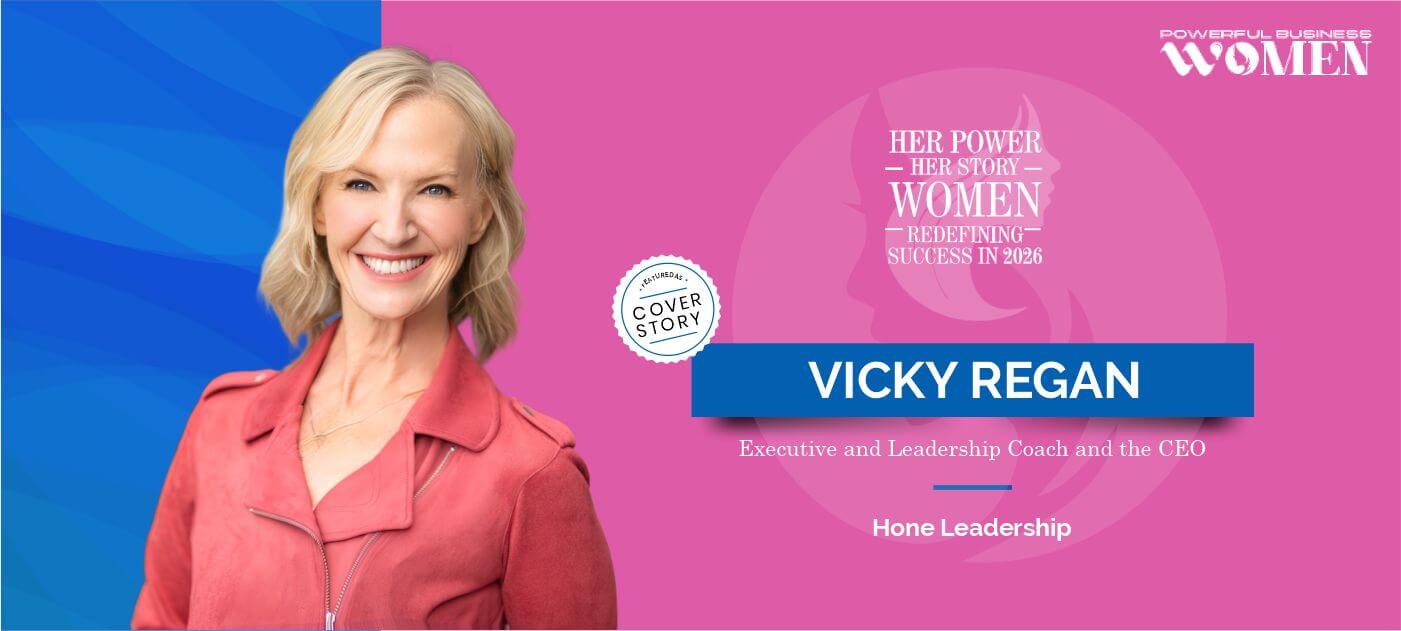
Vicky Regan has spent years working inside that silence. As a credentialed Executive and Leadership Coach and the CEO at Hone Leadership, she doesn’t just develop leaders; she locates precisely where capability and confidence have come apart, and she puts them back together. Her work is structural, rigorous, and built on the kind of sustained observation most organizations never invest in.
The Education That Came Before the Career
Before any corporate floor, before two and a half decades in technology leadership, there was a teenager in the Civil Air Patrol, the auxiliary of the United States Air Force, learning what it meant to be accountable to something larger than yourself.
The Civil Air Patrol gave Vicky an education that, she says, no MBA program replicates: leading under pressure, earning trust through consistency, and understanding that integrity is not a value you hold in theory but a standard you demonstrate in real time, especially when it is inconvenient. These weren’t just abstract principles. They were operational.
Equally formative was her uncle Jim, a pilot whose gift was something far rarer than technical skill. He had an instinct for noticing who needed support, even when they never asked for it. That ability to read the unspoken, to see the person behind the performance, became the invisible thread that runs through everything Vicky does now.
“What struck me then, and still does now, was how instinctive he was at noticing who needed support, even when they never asked for it. That ability to connect shaped how I lead, and it ultimately became part of the foundation for the work I do today.”
A Builder of People, Not a Manager of Them
Ask Vicky to describe herself beyond credentials and titles, and she does not reach for her resume. She goes somewhere more precise.
“At my core, I’m a builder of people, confidence, and clarity. I’m someone who pays attention to what’s not being said, especially in high-performing environments where leaders feel pressure to ‘have it together.'”
The distinction she draws between mentoring and coaching is not semantic. Mentoring, in her view, is the human side of development: the belief someone needs before they can see their own potential, the perspective that opens a door they didn’t know was there. Coaching is something different. It requires structure, clear goals, honest and sometimes uncomfortable reflection, practice, and accountability. The kind that turns insight into lasting behavioral change rather than a good conversation that fades by Thursday.
She does both, but with different intentions. Mentoring happens through pro bono work. The coaching and consulting are where her professional rigor lives, and where she is most often called in when the stakes are at their highest.
Twenty-Five Years, Then a Lightning Bolt
The turn happened after 25 years as a technology executive. Vicky describes it as a decision that arrived with unusual clarity, what she still refers to as a ‘lightning bolt moment.’
The people around her raised predictable concerns: risk, finances, stability. But those objections landed differently for her than they might have for someone acting out of fear. She was acting out of alignment.
“I trusted myself. That decision wasn’t just career-related; it was identity-related, moving from proving myself inside someone else’s definition of success to building a life where my strengths and purpose were integrated.”
It was, she says, the moment self-belief stopped being about credentials and started being about direction. Not a rejection of her corporate past, but a recognition that the next meaningful chapter required building something on her own terms.
The Bias That Doesn’t Announce Itself
Vicky has spent her career in environments where women were underrepresented, and she is matter-of-fact about what that meant. The margin for error felt smaller. The standard for ‘enough’ was applied unevenly. But the bias she identifies as most corrosive isn’t the overt kind. It’s the kind that comes dressed in expectations of decorum.
“The expectation that you should accommodate the room, soften, over-explain, or work twice as hard to be considered ‘enough,’ while simultaneously being careful not to be ‘too much.’ I see this constantly with women leaders: the burden of navigating perception, tone, and likability on top of performance.”
Unlearning it, she says, required choosing clarity over approval. And owning expertise without apology, not as a posture, but as a practice.
The advice she offers women in those positions is unflinching. Stop confusing fitting in with being effective. The real work, she argues, is not imposter syndrome management; it is authenticity, confidence, and communication, learning how to be direct without over-justifying, and visible without feeling performative. And critically, she points to a structural gap: women receive less direct, actionable feedback at work. Her fix is practical.
“Learn how to ask for what you need: ‘What specifically should I do more of, less of, or differently to be seen as ready?’ Clarity builds confidence faster than reassurance ever will.”
Where the Real Work Happens: High-Stakes, High-Sensitivity
Vicky is candid about the kind of work she finds most meaningful, and it is not the straightforward developmental engagements. It is the fragile ones. The situations where a senior leader’s reputation is at risk, where team dynamics have become genuinely destabilizing, where a critical transition is being mismanaged in real time.
These are the assignments that require discretion as much as expertise. Watching those situations turn around, the leader grows, the team stabilizes, the organization regains momentum, represents, for her, the most career-defining work of her practice.
But meaningful impact, in Vicky’s accounting, also includes access. She dedicates 15 percent of her annual services to nonprofits and individuals who are generating real change in their industries and communities. The reasoning is deliberate rather than charitable: leadership development that is only available to well-resourced organizations is a structural problem, not a pricing model.
Success, Redefined at Speed
Vicky’s current definition of success has shifted far from the metrics that shaped her early career. Achievement, title, and promotion still register, but they are no longer the part that feels deeply meaningful.
“In 2026, success means scale with integrity. Today, success is being able to create meaningful leadership impact in a way that’s sustainable, values-driven, and multiplies beyond me.”
She works with individuals, but her emphasis has grown toward the systems that surround them. Organizational engagements allow her to address succession planning, skill gaps, team effectiveness, and culture at a scale that one-to-one coaching alone cannot reach.
On the question of resilience, she draws a distinction that has become central to how she coaches: resilience helps you bounce back; adaptability, in her view, is the actual superpower because it helps you to bounce forward.
“In a world where things don’t just change, but change at record speed, your ability to flex, pivot, and bend without breaking is a game changer. Exceptional leaders are the ones who can stay steady, strategic, and authentic in the middle of complexity.”
The Aspiration
The boldest version of Vicky’s next chapter is, at its core, a systems argument. She wants to help organizations build leadership cultures where feedback, coachability, and development are genuinely normal, not reserved for crisis moments or high-potential programs. The ambition is structural.
As leaders rise in seniority, candid feedback becomes rare and blind spots expand. The coaching and consulting she provides create a structured space to sharpen judgment, strengthen communication, and handle the complexity a senior role demands. But she believes those structures shouldn’t be triggered only when something breaks.
“Leadership development shouldn’t be reactive, something you do only when a leader is struggling or leaving. It should be strategic infrastructure.”
For women specifically, she wants the environments they work in to stop requiring them to decode unspoken rules. The goal is cultures that make the path legible, not just survivable.
What She Wants Young Women to See
When Vicky talks about legacy, she focuses less on scale and more on reframe. She wants young women watching her career to take away a different relationship with confidence, one that is not mystical or innate but built, deliberately, through clarity, practice, and evidence.
She also wants them to see that leadership doesn’t require self-erasure. Warmth and directness can coexist. Empathy and standards are not mutually exclusive. Ambition and integrity can sit in the same sentence without tension.
Her message for International Women’s Day 2026 is, perhaps, the most direct thing she says across the entire conversation.
“You don’t have to earn your right to take up space. You already belong. Stop waiting until you feel perfectly ready. Take the seat. Ask the question. Apply for the role. Start the conversation.”
And then, one step further: if you have influence, use it. Advocate, sponsor, create space. A single direct conversation, a public endorsement, one stretch opportunity handed to someone who needed it, can reshape a career. Possibly several.
“When you rise, make it easier for the next woman to rise too, not by lowering the bar, but by turning the lights on.”