
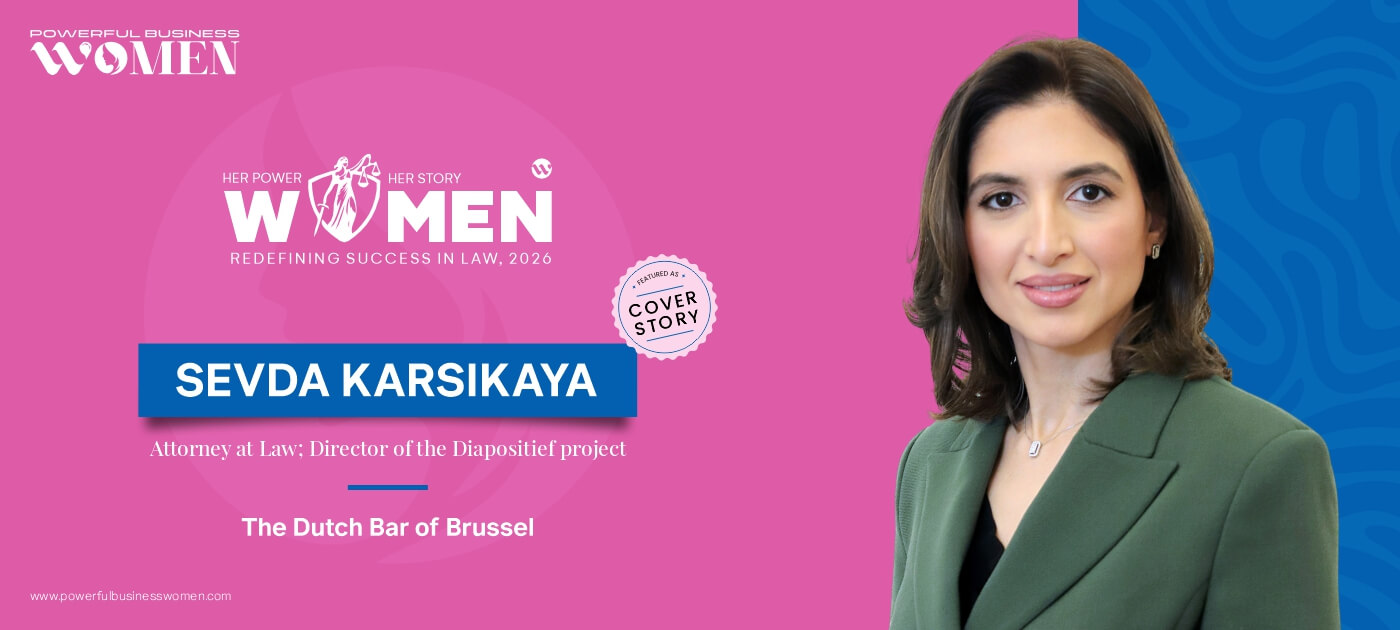

Law does not always arrive gently. At times, it steps in when power has already tipped too far—when authority has stopped listening and dignity has been reduced to a technicality.. In those moments, the law is not about interpretation or procedure alone. It becomes an intervention.
That is the terrain Sevda Karsikaya has chosen to work in.
Across immigration law proceedings, criminal cases, international human rights litigation, and public discourse, her work is situated precisely where imbalance is most visible and consequences are irreversible. It is a space that demands precision without detachment and authority without spectacle. For Sevda, the law has never been an abstract system. It is a living structure that either protects human dignity or fails it. Her career has been shaped by a consistent refusal to accept the latter as inevitable.
That instinct did not arrive with professional training. It was present long before the courtroom.
The Instinct to Intervene
From an early age, Sevda found herself stepping forward when others stayed silent. As a child and during her school years, she was often the first to speak up when someone was excluded, bullied, or overpowered by the majority. It was not driven by bravado, but by a deep sensitivity to imbalance and an early awareness of how power operates.
She learned quickly that defending someone is rarely comfortable and often unpopular. It comes with consequences. Yet she also learned that silence allows injustice to settle in and harden.
Looking back, the continuity is unmistakable. The playground has been replaced by courtrooms and international tribunals. Emotional appeals have given way to legal arguments grounded in fact and law. But the position she takes remains unchanged. She stands where rights are fragile and where a strong, principled voice can shift the outcome from injustice to dignity.
A Conscience-Driven Practice
Beyond her professional title, Sevda describes herself as someone guided by conscience rather than recognition. She listens carefully, not only to what is said, but to what is avoided. Her decisions are deliberate, shaped by responsibility rather than visibility.
Her work exposes her daily to human suffering, conflict, and moral complexity. Resilience, in that context, is not about emotional distance. It is about remaining steady without becoming indifferent. For her, strength does not lie in hardness, but in clarity; knowing where one stands even when the ground is unstable.
At the core of her practice is a belief that law and humanity are inseparable. Rules only matter if they protect dignity. Authority only matters if it serves justice. Whether she is arguing a case, engaging in public debate, or mentoring future lawyers, that principle remains fixed.
Redefining Success Through Alignment
By 2026, Sevda’s definition of success has moved decisively away from external validation. Early in her career, credibility, winning cases, and proving competence were necessary markers. Today, they are no longer decisive.
Success, for her, is alignment. Alignment between values, choices, and impact.
It is the ability to act where it matters without erasing oneself in the process. To work selectively, to use public voice with intention, and to treat boundaries as a form of leadership rather than retreat. Influence, in her view, is not about prestige but effect; opening doors, shifting perspectives, and demonstrating that authority and empathy are not opposites.
If her work contributes to a view of power that is principled rather than performative, and to a version of success that is meaningful rather than exhausting, she considers that a true measure of achievement.
Confidence as a Professional Requirement
Unlike many leadership narratives, Sevda does not point to a single moment where self-doubt transformed into self-belief. In her work, confidence is not an emotional milestone. It is a functional necessity.
“When you are defending clients whose liberty, family, or safety is at stake, hesitation is simply not an option,” she expresses firmly.
Arguing cases at the highest level, including before international courts, reinforced that reality. What matters in those settings is not how one feels, but mastery of the facts, the law, and the consequences of every argument made. Her focus has never been on belonging, but on whether an argument is correct, necessary, and legally sound.
That kind of confidence does not need to be built. It follows from responsibility and rigor.
Authority Without Overcompensation
As an independent practitioner, the barriers Sevda encountered were less about internal doubt and more about external expectation. In legal and media environments, authority is still too often associated with institutional backing or male voices. Those who fall outside that traditional profile find their authority tested more quickly, often implicitly.
The challenge lay in navigating the space between visibility and underestimation. Decisiveness and strategic judgment are not always anticipated when they are not supported by conventional markers of power.
What took the longest to unlearn was the impulse to over-explain or over-perform in order to pre-empt doubt. Over time, clarity replaced overcompensation. Authority, she learned, is built through consistency, results, and precision, not excess justification. This insight has only strengthened the way she works.
Impact Measured in Consequence
The milestones that matter most to Sevda are defined not by scale or exposure, but by consequence.
In immigration law, particularly family reunification cases, impact is tangible and immediate. Parents holding their children again after years of forced separation. Partners rebuilding a life in Belgium after long and exhausting procedures. For individuals who lived invisibly for years without legal status, lawful residence is not symbolic. It is the difference between survival and a future.
In human rights litigation, impact takes another form. Successfully litigating cases of police violence before the European Court of Human Rights meant holding state authorities accountable where power crossed into abuse. These judgments matter beyond the individuals involved. They reaffirm that force must always be constrained by law and dignity, even when exercised in the name of authority.
Appearing before the court of assizes brings yet another dimension. It is where liberty, responsibility, and irreversible facts converge. The lawyer’s role there is both technical and profoundly human.
Passing the Law Forward
Impact, for Sevda, also lies in transmission.
As Director of the Diapositief project at the Dutch Bar of Brussels, she works with final-year secondary school students from migrant backgrounds who aspire to study law. She designs a substantive programme and brings them into direct contact with judges, lawyers, and prosecutors’ substitutes. Through those encounters, justice becomes tangible. Distance gives way to possibility.
Across courtrooms, classrooms, and international institutions, the unifying thread is lasting effect. The law matters most when it alters a life’s trajectory and reasserts limits on power.
Refusing to Shrink
Her advice to women navigating leadership spaces is precise and uncompromising.
“Do not confuse adaptation with erasure.”
Understanding how systems work is strategic. Diminishing oneself to fit into them is not. Leadership spaces may reward familiarity, but shrinking carries a high cost. Authority comes from coherence, not imitation. Every refusal to disappear creates room for someone else to remain whole.
Presence Is Not Negotiable
On International Women’s Day 2026, Sevda’s message is clear.
“Your presence is not negotiable.”
Women do not need permission to take space, to speak with authority, or to exist fully. Courage is not always loud. Sometimes it is the quiet refusal to accept injustice as normal. Each such choice strengthens the ground for others.
The Next Chapter
Looking ahead, her boldest aspiration is to deepen impact without narrowing scope. She intends to continue working at the intersection of law, human rights, and public discourse, where legal outcomes shape societal standards rather than remain confined to courtrooms.
This includes taking on cases that challenge abuse of power at its core, especially where state authority meets individual vulnerability. It also means using her public voice with greater deliberation, insisting on nuance in an increasingly polarized world.
Above all, she aims to remain uncompromising in substance while evolving in form; mentoring, influencing, and helping shape a legal culture where strength is measured by accountability rather than dominance.
Making Authority Visible
Through her regular appearances on television discussing law and current affairs, Sevda has become a visible reference point. Parents and young people often approach her to describe what that visibility represents. Recognition. The realization that the law is not a closed world.
For young women watching, she hopes her story makes one thing unmistakable. Authority does not require adaptation or self-erasure. Speaking up is not arrogance. It is leadership. Integrity and strength are not opposites. They can, and must, exist together.
If that understanding travels forward with them, then the impact has already begun.