
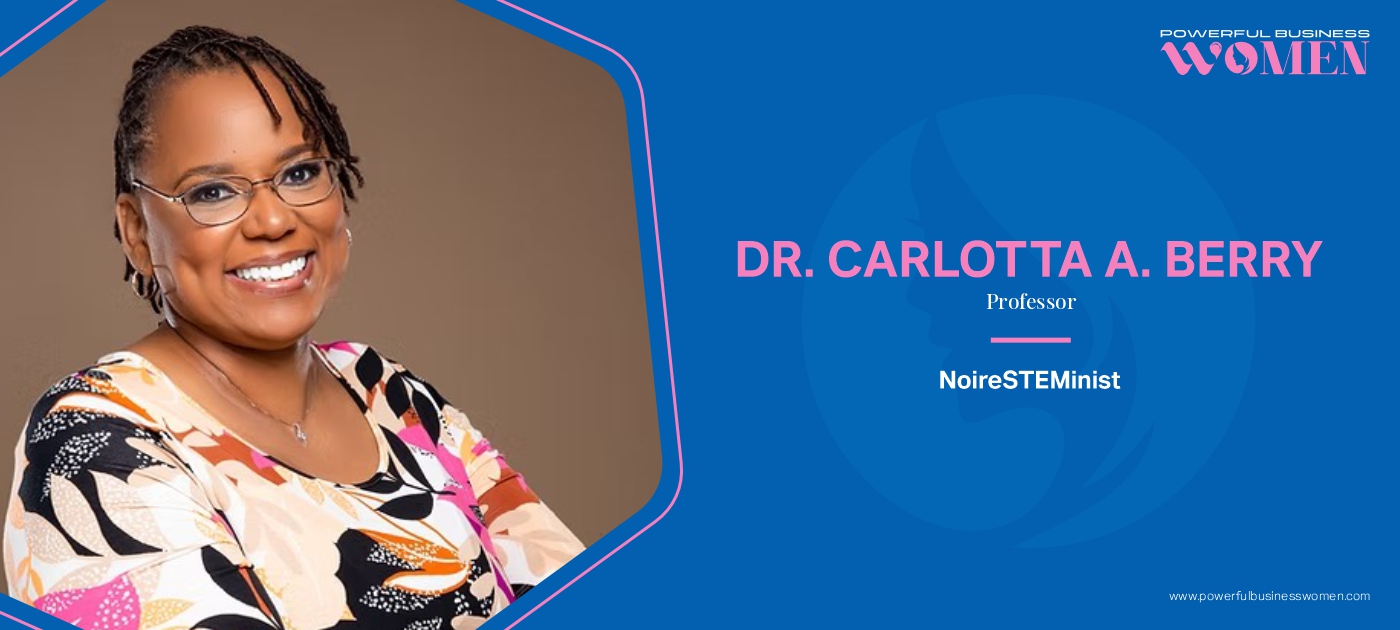

The pandemic forced many industries to pause, but for some leaders, it became the catalyst for long-overdue transformation. STEM education was among the hardest hit—students found themselves cut off from labs and equipment, while communities already underserved in science and technology fell even further behind. The disruption exposed a truth that many had ignored: access to STEM education has never been equal, and the traditional pipeline approach wasn’t working for everyone.
Dr. Carlotta A. Berry saw the crisis differently. As a professor of electrical and computer engineering at Rose-Hulman Institute of Technology and the Lawrence J. Giacoletto Endowed Chair, she had spent years watching brilliant students light up when they built their first robot. But she had also witnessed too many others—particularly Black and brown children—never get that chance. When the world shut down in 2020, she asked herself the hard questions: “What more can I do? How can I make my work matter beyond the classroom?”
Her answer became NoireSTEMinist® Educational Consulting, LLC, and with it, a mantra that would define her mission: “My STEM is for the streets.”
Robotics for the Streets
Berry’s journey to entrepreneurship wasn’t a dramatic pivot—it was the natural evolution of a lifetime spent both inside and outside STEM. Growing up in Nashville, Tennessee, she was the little girl taking apart toys, fascinated by how things worked. That curiosity carried her through Spelman College, Georgia Tech, Wayne State, and finally Vanderbilt, where she earned her Ph.D. in electrical and computer engineering with a focus on human-robot interaction.
But technical credentials alone don’t tell her story. As a Black woman in engineering, Berry rarely saw herself reflected in classrooms or workplaces. “The path wasn’t always welcoming, but I stayed because I believed representation matters—not just for me, but for those coming after me,” she explains. That belief became the cornerstone of everything she would build.
NoireSTEMinist® was born from a simple but radical idea: STEM shouldn’t live only in elite labs or expensive classrooms. It belongs everywhere—libraries, community centers, living rooms, and local schools. Berry started creating robotics workshops using open-source tools like Arduino, Tinkercad, and 3D-printed components. She made videos, ran demonstrations, and hosted virtual sessions so that anyone, regardless of background, could get hands-on with robotics.
“I didn’t want to wait for students to come to me—I wanted to meet them where they were,” Berry says. She took what she had been doing for years in academia and reimagined it for accessibility, equity, and reach.
The Flower∞Bot Revolution
The most defining turning point in Berry’s career came when she launched the There’s A Robot! children’s book series alongside the Flower∞Bot robotics platform. Together, they represent more than educational tools—they’re cultural connectors designed to show children, especially Black and brown children, that they belong in STEM from the very beginning.
Flower∞Bots are open-source, low-cost, modular robots that “grow” with the learner. A child can start with a simple Daisy∞Bot powered by Arduino, progress to Lily∞Bot with more sensors, or eventually tackle Rosie-bot using advanced controllers and programming languages. They’re 3D-printed, affordable, and endlessly customizable—eliminating the barriers that have kept too many people out of STEM.
“I’ve seen too many people turned away from STEM because they didn’t have the right tools, the right school, or the right mentors. Flower∞Bots eliminate those barriers,” Berry notes.
The impact has been profound. Five-year-olds coding their first robot. Parents learning alongside their children. College students stretching their creativity with advanced modules. And perhaps most importantly, kids pointing at illustrations in her books and saying, “That looks like me!” That moment of recognition changes everything.
The Tough Calls of Leadership
Building a movement while maintaining a full-time faculty position required Berry to make difficult decisions. One of the hardest was learning when to say no—specifically, when to stop giving away her expertise for free.
“Passion alone cannot sustain a mission,” she acknowledges. Countless speaking requests and workshop invitations came without compensation, even when they required significant time and travel. Berry had to establish boundaries, capping her pro bono events while offering discounts for nonprofits and charities.
The decision was transformative. “Leadership is not just about giving endlessly—it’s about making strategic choices that ensure the mission thrives,” she reflects. By valuing her time, she reinforced a critical message to young women and underrepresented groups in STEM: “Your work, your knowledge, and your voice have value. You deserve to be compensated for your contributions, just as anyone else would.”
Berry also embraced delegation, hiring a virtual assistant, working with editors and illustrators, and partnering with colleagues to develop AI tools for her business. “Leadership is not about doing it all yourself—it’s about building a team, leveraging resources, and trusting others to help bring your vision to life.”
Breaking the Myth
If Berry could debunk one myth about women in leadership, it would be the persistent belief that women cannot simultaneously be visionary, strategic, assertive, and trailblazing without being penalized for it. “Men exhibiting the same traits are praised as strong and decisive, while women are questioned. That double standard is not only exhausting—it is destructive to progress,” she states emphatically.
Her work speaks for itself. Beyond founding NoireSTEMinist®, Berry co-founded Black In Engineering and Black In Robotics during the 2020 social justice movement, creating global communities that connect and empower Black professionals in these fields. She established the Rose Building Undergraduate Diversity (ROSE-BUD) program to support women and underrepresented students. She’s written children’s books and, under the pen name Carlotta Ardell, romance novels featuring Black women in STEM.
“Assertiveness is not aggression. Vision is not arrogance. Passion is not anger. Leadership is leadership. Period,” Berry declares.
The Legacy of Representation
When Berry thinks about her legacy, she doesn’t focus on robots or technical achievements. She thinks about people—specifically, who gets to sit at the table when the next life-changing technology is designed.
“Too often, technology reflects the blind spots of its creators,” she explains. Facial recognition systems that misidentify people of color. Medical devices untested on women. These aren’t just technical oversights—they’re reflections of who is missing from the design room.
“When more women, Black, and Brown people are in STEM, the products we build are not only technically brilliant—they are also equitable and inclusive,” Berry emphasizes.
Her ultimate goal is simple but profound: “I want young women and students of color to look back and say, ‘I stayed in STEM because I saw someone who looked like me leading the way.'”
Through NoireSTEMinist®, Berry has created more than a consulting company. She’s built a movement that proves STEM isn’t a pipeline with one narrow entry point, but a pathway with many doors. Every workshop, every robot demonstration, every children’s book is a reminder that STEM belongs to all of us.
Because representation matters. And as Berry proves every day, when we diversify STEM, we don’t just change the face of technology—we change the world.