

Leadership is being tested like never before. The rules that once shaped boardrooms and C-suites are eroding under the weight of relentless change. Global instability, technological disruption, cultural fragmentation, and the rising demand for authenticity are rewriting what it means to lead. In this environment, traditional playbooks often collapse. A glossy vision statement or a carefully crafted strategy isn’t enough.
The real challenges lie deeper—inside entrenched cultures, outdated mindsets, and the silent battles leaders fight with themselves. That’s where the future of leadership is being defined.
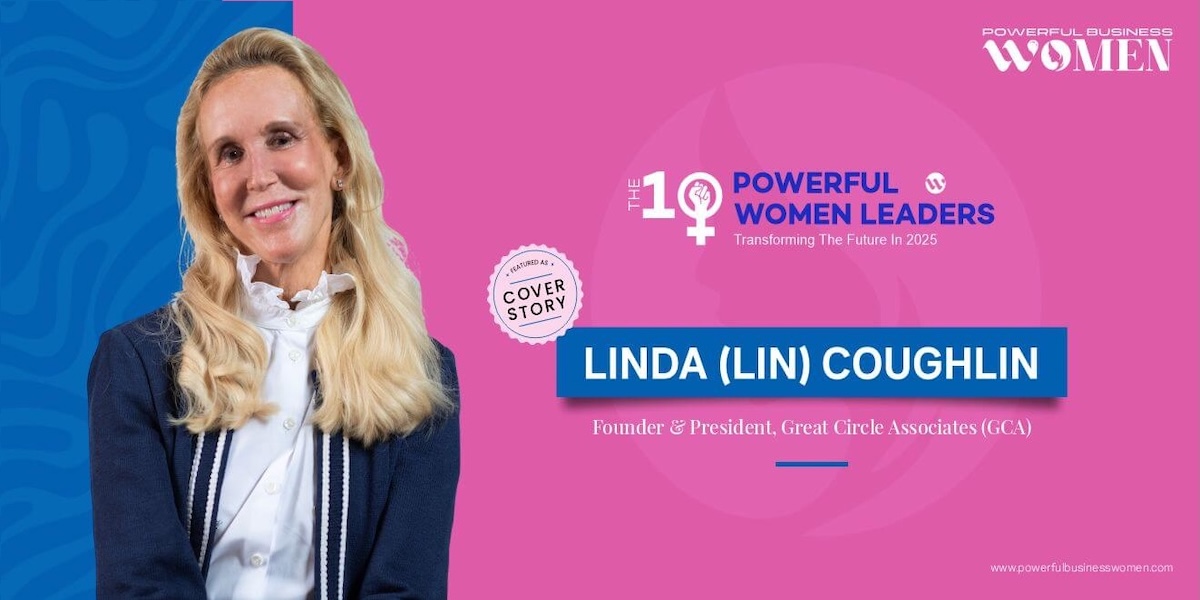
Few people understand this truth better than Linda (Lin) Coughlin, Founder and President of Great Circle Associates (GCA). For nearly two decades, she has been at the forefront of leadership transformation, guiding CEOs, boards, and senior teams through the kind of change that shakes organizations at their core. Her signature philosophy—Change at Core™—isn’t about tweaking systems or rebranding logos. It’s about unearthing the habits, norms, and beliefs that hold organizations back, and daring to replace them with something bolder, better, and enduring.
“Successful transformation is about more than strategy—it’s about fostering accountability, inspiring belief in what’s possible, and building an enduring culture of empowerment and growth,” Linda says.
Her story, however, is not that of a consultant who studied leadership from the outside. It is the journey of a corporate leader who lived through the trenches of change, learned from the weight of responsibility, and then chose to dedicate her career to helping others navigate the same.
Learning to Lead by Empowering Others
Lin’s rise in corporate America came with an approach that stood out in male-dominated boardrooms. Unlike leaders who thrived on being the loudest or smartest in the room, Lin built her success by surrounding herself with talent that could, as she says, “do circles around me.”
She invested deeply in her teams, coaching and mentoring them to embrace growth mindsets, play to their strengths, and take measured risks. She wasn’t just driving quarterly results—she was cultivating leaders.
“I worked hard to create the full partnership of men and women leaders in male-dominated environments,” she recalls. “That required me to master active listening, exercise a laser focus on results, and ensure that every team member was recognized for their achievements.”
This philosophy shaped her identity as a leader: part strategist, part mentor, part visionary. And it was precisely this combination that made her transition into executive coaching and advisory work feel less like a career pivot and more like a calling.
Even before founding Great Circle Associates, Linda codified six values that became the compass for her leadership. Unlike mission statements written for annual reports, these values were lived, tested, and refined over decades:
- The celebration of uniqueness: Embracing differences in backgrounds, work styles, and perspectives as sources of strength.
- Generosity of spirit and action: Leading with compassion, balancing the needs of customers, employees, shareholders, and communities.
- Professional and intellectual humility: Acknowledging fallibility while striving for excellence.
- Reciprocity: Giving as much as you receive—guided by the principle, “to whom much is given, much is expected.”
- Transparency: Making decision-making and problem-solving visible and candid.
- Passion for eliminating the status quo: Challenging entrenched patterns to create breakthroughs.
“These values have endured, and I have practiced them for 30 years. They are the bedrock foundation of my consulting practice,” Linda says with conviction.
What makes these values powerful is not their phrasing but their application. They became the scaffolding upon which she built cultures of accountability and collaboration—even in environments resistant to change.
One defining episode from Linda’s corporate years reveals the DNA of her approach to leadership. Tasked with integrating an acquired company into her own, she faced fierce resistance. The acquired company’s leaders believed they should have been the acquirer. Their performance, they argued, was stronger—and in some ways, they were right.
Instead of shutting down the dissent, Lin leaned into it. She made it her mission to build trust with the naysayers, engaging influencers at every level and uncovering what their culture did better. She then set about weaving those strengths into the new organization’s fabric.
The process wasn’t fast or easy. But through dialogue, shared vision-setting, and bold operational moves, Linda and her team consolidated operations, redefined pricing strategies, and turned loses into profits.
This wasn’t just change management—it was Change at Core™ in action before it even had a name. It proved to Lin that sustainable transformation requires both strategic boldness and cultural humility.
The Leap into Entrepreneurship
By the mid-2000s, Linda had a decision to make. After decades of corporate leadership, she could have stayed the course, continuing to climb and manage billion-dollar assignments. . But she felt a deeper calling.
“I was on a mission to share what I had learned about transformational leadership,” she explains. “It was natural for me to become an executive coach focused on collaborating with leaders and leadership teams who are at big inflection points in their careers.”
In 2008, she founded Great Circle Associates (GCA)—a consulting and executive coaching firm dedicated to helping leaders drive transformational change with courage and clarity. From day one, her vision was not about incremental improvement. It was about decisive, sustainable breakthroughs.
The firm’s mission is clear:
“To enable the strategically considered, rapid, and well-executed implementation of sustainable Change at Core™ at the enterprise, team, and individual levels in support of ambitious growth or turnaround goals and strategies.”
What distinguished GCA in a crowded consulting space wasn’t just methodology. It was Lin’s unique blend of strategic rigor and human-centered coaching, honed by years of personal and professional trial. She understood both the exhilaration and the exhaustion of leadership, the thrill of success and the weight of self-doubt.
Her journey, however, wasn’t without struggle. As a mother of four, Linda grappled with what she candidly calls “imposter mom” syndrome. While breaking through corporate glass ceilings, she often battled guilt—questioning if her ambition came at too high a cost.
The turning point came during a tense board meeting she was chairing. When a volatile board member verbally abused staff during a presentation, Linda drew a hard line—excusing non-board members from the room and declaring that the meeting could not continue under such conditions. She won support, carried the vote, and protected her team’s dignity.
But the incident left her shaken. Driving home that evening, she realized the nausea she felt wasn’t just from conflict. It was the resurfacing of her own internal narrative—that perhaps, in pursuing her career so fiercely, she had failed as a mother.
With the support of trusted advisors, Linda reframed her perspective. She came to see that the quality of time with her children was deeply tied to the fulfillment she gained from her career. By giving herself grace and rejecting perfectionism, she emerged stronger—both as a leader and as a mom.
“When I finally freed myself of the guilt, I showed up as a balanced high-impact leader, but more importantly, as a more loving, engaged, and committed mom,” she reflects.
This vulnerability is part of what makes Lin’s coaching so impactful. She doesn’t coach from a pedestal; she coaches from lived experience.
Laying the Groundwork for Transformation
By the time Great Circle Associates gained momentum, Linda’s approach had crystallized. She wasn’t simply offering leadership advice—she was building a movement.
She codified her philosophy into structured frameworks, most notably the Nine-Step Change at Core™ Process, and began guiding leaders through transformations that didn’t just change performance metrics but redefined organizational cultures.
Her clients—CEOs, boards, and senior teams—quickly realized that working with Lin wasn’t about checking boxes. It was about embarking on journeys of self-discovery, accountability, and bold reinvention.
And while the frameworks provided structure, it was her ability to blend strategy with humanity that left the deepest impact.
Change at the Core of Leadership
When Lin Coughlin talks about transformation, she doesn’t mean tweaking around the edges. She means the kind of decisive, uncomfortable, and ultimately liberating change that alters an organization’s very DNA. She calls it Change at Core™.
“Change at Core™ refers to decisive departures from deeply embedded mindsets and mature entrenched cultures, structures, and problem-solving approaches,” Lin explains. “It’s the hardest kind of change to anticipate, plan for, and masterfully execute. But it’s also the kind of change that unlocks real breakthroughs.”
Over nearly two decades, Linda has refined a Nine-Step Process that guides leaders through this journey:
- Develop and communicate a bold, compelling vision anchored in the “why.”
- Create urgency by engaging stakeholders and confronting market realities.
- Reinforce new behaviors with clear, frequent communication.
- Generate and celebrate short-term wins to build belief.
- Codify values and cultural norms that align with mission and strategy.
- Build a coalition of passionate champions who influence across silos.
- Empower execution through coaching, mentoring, and risk-taking.
- Consolidate gains to drive deeper transformation.
- Institutionalize change through systems, leadership development, and succession.
It’s a roadmap that balances bold strategy with cultural empathy. And it works because it doesn’t shy away from the human side of change. Leaders don’t just implement; they grow, adapt, and evolve alongside their organizations.
Linda’s work as an executive coach goes beyond helping leaders hit performance targets. Her approach is about aligning three interconnected dimensions—life, leadership, and business—into one integrated whole.
She describes it as a three-legged stool:
- Life Coaching: Cultivating resilience, balance, and clarity of purpose.
- Leadership Coaching: Building emotional intelligence, influence, and team alignment.
- Business Coaching: Driving strategy, execution, and organizational priorities.
“If one leg is neglected, the stool collapses,” she notes. “Leaders don’t leave their personal lives at the office, nor their leadership at home. Everything is connected.”
Her sessions often shift fluidly between domains—helping a client manage burnout in one moment, then guiding them through market positioning or stakeholder alignment in the next. By weaving these threads together, Linensures her clients grow not only as executives but as whole human beings.
Confronting the Silent Enemy: Imposter Syndrome
Among all the barriers Lin has helped leaders confront, one stands out as both pervasive and deeply personal: imposter syndrome.
Imposter syndrome afflicts more than 70% of leaders. Some of the most accomplished figures—including Michelle Obama, Sheryl Sandberg, and Howard Schultz—have admitted to experiencing it.
Lin has lived through it herself. She knows the paralysis of self-doubt, the obsession with perfection, and the constant fear of not being enough. That’s why she has made it her mission to dismantle imposter syndrome for her clients.
Her eight coping mechanisms form a practical toolkit:
- Recognize imposter feelings in real time.
- Remember you’re not alone.
- Share with trusted peers.
- Face fears in the moment.
- Set bold yet realistic goals.
- Visualize success.
- Reframe failure as learning.
- Focus on strengths and accomplishments.
“My vision is to eliminate imposter syndrome,” Linda says passionately. “Imagine the breakthroughs leaders could achieve if they weren’t shackled by the fear of being discovered as frauds.”
By normalizing the conversation around imposterism, Linda not only helps leaders free themselves, but also dismantles the cultures of silence that allow self-doubt to thrive.
If imposter syndrome is the internal enemy, toxic cultures are the external one. Lin has seen firsthand how politically motivated dysfunction corrodes trust, disengages employees, and drives away high-potential talent.
Her answer: a four-step methodology for operationalizing values cultural norms and associated desired behavior into everyday practice:
- Benchmark the real and perceived practices of values and cultural norms in action through 360 assessments and surveys.
- Tie the practice of values and cultural norms to performance measurement so they’re more than posters on the wall.
- Feature cultural wins in internal communications to show proof of impact.
- Hold senior leaders accountable for role modeling desired behaviors.
For Linda, this isn’t window dressing. It’s the foundation of sustainable transformation. Leaders who codify and live their values and cultural norms create organizations where innovation and trust can flourish.
Even as she champions timeless values, Lind is far from traditional. She actively embraces AI for research, analysis, and planning, using technology as a tool to accelerate positive disruption. She’s also building an online leadership development platform to extend her impact beyond one-to-one coaching.
Yet, at the heart of her work remains a commitment to humanity. Her mantra for leaders is simple but profound:
“Be better today than yesterday; be better tomorrow than today.”
It’s a reminder that leadership isn’t static. It’s a practice—rooted in self-awareness, humility, and service.
A Vision for the Future of Leadership
Looking ahead, Linda is focused on four priorities:
- Eliminating imposter syndrome so leaders can operate free from self-doubt.
- Fostering more high-impact women change-makers to create full partnerships in leadership.
- Promoting intergenerational dialogue that bridges experience with fresh perspective.
- Challenging outdated models of power to build leadership rooted in shared impact.
She envisions a future where leadership is less about hierarchy and more about connection. Where the most respected leaders are not those with the loudest voices, but those who cultivate authentic relationships with all stakeholders.
“I want to be remembered not just as a change-making executive coach and strategic advisor, but as someone who helped restore leadership to its rightful place—as a calling, not a crown,” she says.
After more than four decades of leading, coaching, and advising, Linda’s impact is still accelerating. She has guided organizations through seismic transformations, helped hundreds of leaders confront their deepest fears, and modeled a leadership style grounded in courage and humility.
Her legacy is not a single framework or methodology. It is a philosophy: that the future of leadership lies in embracing humanity, challenging the status quo, and daring to change at the core.
For those ready to step into that future, Lin Coughlin is both a guide and a mirror—helping leaders see not only what their organizations can become, but who they themselves are meant to be.
Company URL: greatcircleassociates.com






 Coughlin, Founder of Great Circle Associates, transforms organizations through her Change at Core leadership philosophy.)